Models & Performance
TwoFiftyTwo exposes model selection directly in the Research interface and in each Analyst task. This page documents the available models and the evaluation results used to guide model selection for different research use cases.
Available models
Opus (1M)
The default model. Opus runs with a one-million-token context window and excels at nuanced reasoning, long-chain analysis, and synthesising conflicting or ambiguous source material.
Best for: Most financial research tasks — earnings analysis, credit reviews, cross-source synthesis, and any deliverable where accuracy on complex or conflicting evidence matters.
Sonnet 4.6 (1M)
Sonnet 4.6 runs with a one-million-token context window and scores within a few points of Opus across retrieval and synthesis tasks, with slightly faster response times.
Best for: Quick lookups, exploratory queries, or high-volume workflows where speed is a priority and the reasoning ceiling is less critical.
GPT 5.5 (272K)
OpenAI’s GPT 5.5, available with a 272,000-token context window. Offers an alternative reasoning profile for tasks where a second perspective on the same sources is useful.
Best for: Comparative analysis, situations where you want a non-Anthropic model’s interpretation, or workflows that already rely on GPT-family outputs.
Effort level
The Effort level in the prompt bar affects the depth of the research plan, not the underlying model. The default is High.
| Setting | Behaviour | Best for |
|---|---|---|
| Medium | Generates a simpler plan and responds faster. Fewer research steps, narrower source coverage. | Quick factual lookups, exploratory queries, or checking whether TwoFiftyTwo has relevant data before committing to a full run. |
| High (default) | Generates a detailed multi-step plan before writing. Broader source coverage and better-structured output at the cost of slightly longer processing time. | Most financial research tasks — earnings analysis, credit reviews, thematic deep-dives, and any output that will be shared or archived. |
| Max | Generates the most exhaustive research plan. Maximum source coverage and the most thorough synthesis, with the longest processing time. | High-stakes deliverables where completeness is critical — investment committee memos, regulatory filings, or deep cross-source analysis. |
Choosing an effort level
Default to High for anything shareable, drop to Medium for speed during live discussions or data-availability checks, and reserve Max for high-stakes deliverables where missing a nuance has real consequences.
Effort level is independent of the model — all three settings run on whichever model is selected in the Model control.
Evaluations
Note: Results below are from the V1 benchmark run. GPT 5.5 was not included in this run and will be added in a subsequent evaluation.
Task types
Three task types are evaluated:
- Retrieval — extracting a specific factual value from a data provider or email corpus.
- Synthesis — summarising or aggregating information across multiple emails or sources.
- Reasoning — drawing an inference or interpretation from provided data or context. Golden answers are written by a domain expert showing the expected logical flow for the specific market context.
Evaluation framework
Each response is scored across four dimensions and subject to a hallucination gate.
- Correctness — factual accuracy at the statement level.
- Source Attribution — whether claims cite the correct data provider.
- Completeness — whether all required elements from the golden answer are present in the response.
- Conciseness — the proportion of assertions in the response that directly contribute to answering the query.
- Hallucination gate — contradicted assertions are not scored; they fail the response outright.
Results — V1 benchmark run
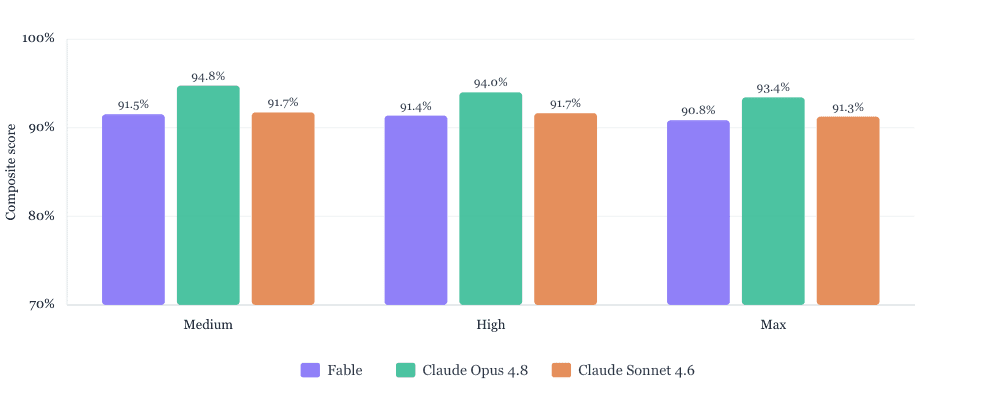
Claude Opus 4.8 leads across all three effort levels, with Claude Sonnet 4.6 and Fable closely grouped behind it. The spread between models is narrow, with all three models exceeding a 90% composite score — suggesting the choice of effort level has limited impact on absolute quality within this range.
Sonnet 4.6 is notably consistent: its composite score holds within 0.4 points across Medium, High, and Max. Opus shows a slightly larger drop at Max, which may reflect the more demanding research plans surfacing harder edge cases. Fable follows a similar pattern to Opus but scores lower overall.
Opus at High is the recommended choice for most tasks. Sonnet 4.6 is a strong alternative when response speed matters more than ceiling quality — the composite scores stay close across Medium and High effort levels.