Hit Rate
The Hit Rate page measures the performance of trade ideas over time. It ranks analysts and asset classes by accuracy, giving you an evidence-based view of who is generating the most value and where signal quality is highest.
Rankings
The Rankings table ranks analysts and asset classes by hit rate, and can be filtered down to a specific analyst or asset class. Rankings update as trade ideas close or reach their target horizon.
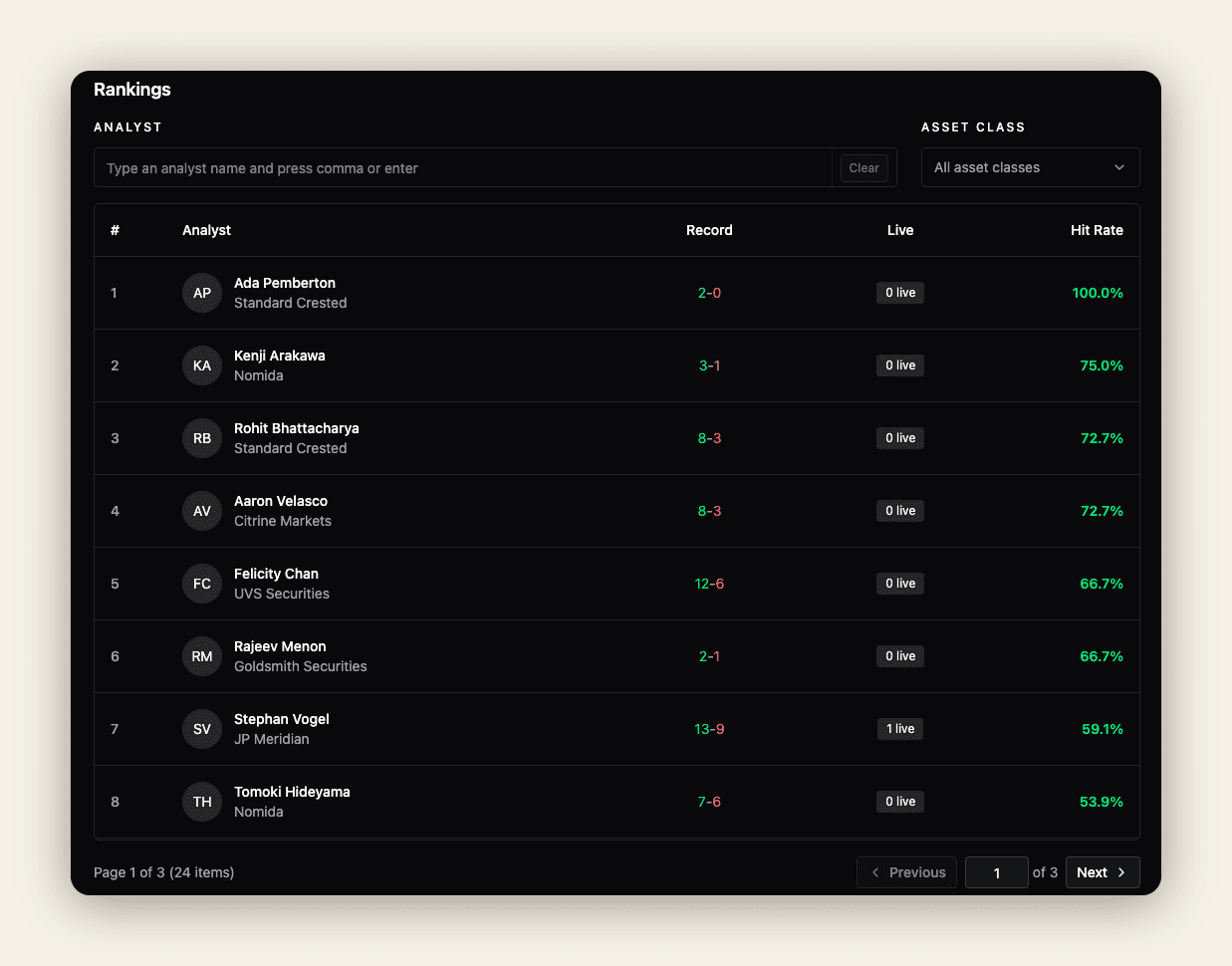
How hit rate is calculated
A trade idea is considered a hit when the underlying position moves in the predicted direction by the time the idea’s target horizon is reached. The exact verification logic depends on how your data sources are configured.
The hit rate percentage is the proportion of closed ideas that were hits, expressed as a percentage.
Trade verification
Trade verification must be enabled on your data sources for new ideas to be evaluated automatically. If verification is disabled — either globally or for specific sources — the following applies:
- Existing live trades continue to run to completion and will be evaluated.
- New trades ingested while verification is disabled will not be added to the evaluation queue.
To enable trade verification, go to Data Sources and review the verification setting for each source. Verification settings are also accessible from the Verification settings button in the top right of the Hit Rate page.

Using hit rate data
Hit Rate is most useful when you have a meaningful number of evaluated ideas — typically 20 or more per analyst or asset class before rankings become statistically meaningful. Treat early rankings directionally, not definitively.
Common uses:
- Identifying analysts whose calls deserve higher weighting in your process
- Spotting asset classes where internal research is adding alpha versus where you may be relying too heavily on external views
- Benchmarking improvement over time as you refine how ideas are generated and captured